Natural Paddock
Our philosophy
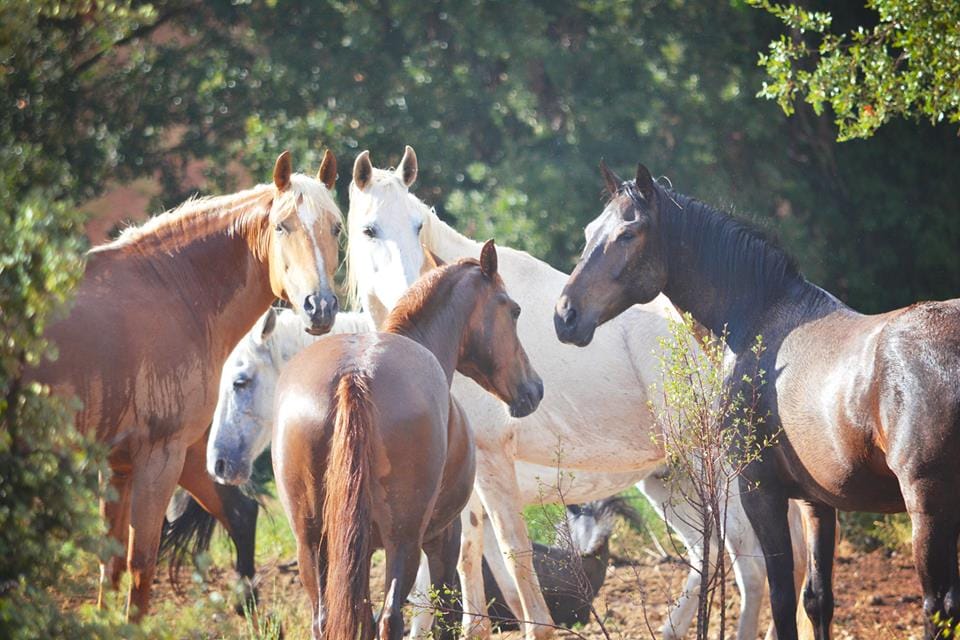
The horse is a social animal, a herbivore, and in constant movement. Caring for one properly starts by respecting those three things: give it a group, give it the right diet, give it land.
Physical and mental welfare
A horse's welfare depends on its habitat and social structure resembling those of a natural band. Natural groups have between 2 and 12 individuals: a horse needs company and should never live alone.
Diet
80% is forage grass. The remaining 20% is fruit, roots, leaves, medicinal herbs and shrubs. They drink around 35 litres of water a day, so access to water matters as much as forage.
At Natural Paddock we spread organic forage across the enclosure every day and place water and food at distant points: this way the horse walks to reach them, just as it would in the wild.
Biological habitat
The horse evolved in arid, steppe-like environments. Feral horses cover an average of 16 km a day, with peaks of up to 50 km. A stall is not its habitat. Neither is a small paddock.
Handling principles
- Barefoot. No horseshoes. A healthy hoof takes care of itself through movement and careful maintenance.
- No bit and no gear that causes pain. A horse cooperates if the bond is well built; there is no need to force it.
- Proper diet and water, both in quantity and in place. Movement comes from having to go and get them.
- Learning its language is the first step. No training method should produce pain, fear or stress: if it does, it is being misused, or it should be discarded.
- Observation. The most useful tool and the most forgotten one. Before intervening, watch.